

Improvement and Transformation Teams seeking to prioritise the user journey and foster a user-first approach often rely on the tool of user story mapping. Devised by Jeff Patton, this tool fosters a cross-disciplinary dialogue that enables a team to examine an entire user experience from start to finish. Once the mapping process is complete, the team engages in a “good, better, best” exercise to pinpoint different ways and effort levels to facilitate the required user task. The final step involves collaboratively “slicing” releases from the map that offer value to the customer, reducing both initial investment and time to market. Over the past decade and a half, user story mapping has emerged as a crucial tool for product managers and teams.
The Interplay between User Story Mapping and OKRs
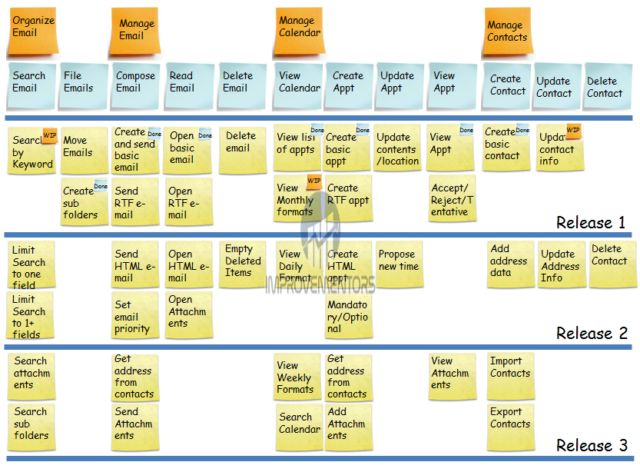
If your team is grappling with the identification of objectives and key results (OKRs), user story mapping can be a potent tool to streamline your progress. Each post-it note in a user story map should encapsulate a “brief action phrase.” Examples might include “log into my account,” “add item to shopping cart,” or “choose credit card for payment.” During the collective construction of the user story journey, highlight any actions that you believe are vital to the success of the user journey and align with the company’s current strategic priorities.
Each identified item, when framed as a “short action verb phrase,” represents a customer behaviour during system use. The user story mapping process offers an aggregation layer, allowing you to group similar tasks into activities (e.g., “complete a purchase”). These, too, are brief action verbs. In essence, every element in the story map’s “backbone” and each “activity” grouping is a potential key result.
The objective for your team is to pinpoint where to concentrate your immediate efforts. This will necessitate understanding the company’s current strategic priorities and where you and your team can make the most significant impact. With these factors in mind, you can select a set of customer behaviours to potentially transform into your key results. The advantage of the user story mapping process is that if it’s conducted as a team effort, the team can also collaborate to set its own goals (a critical success factor for OKRs) within the system’s context rather than making isolated decisions.
How Story Map-based OKR Selection Enhances Your Release Strategy
The final stage in user story mapping involves “slicing” potential releases from the identified functionality that could enhance the user journey. If you’ve already chosen your key results from the map, this process is simplified. A clear understanding of the behaviour you aim to influence in the immediate future allows you to craft a release strategy that delivers customer value and aligns with the company’s strategic objectives. For instance, if customers have no problems logging into the system but struggle to add items to their shopping cart, which is a primary focus for the company this quarter, your initial few “slices” of functionality might concentrate on addressing this issue before moving onto other features in the user journey.
The User-Centric Nature of Story Maps Can Unblock Teams Setting OKRs
By design, story maps are user-focused. Collaborative construction of these maps with product, design, and engineering teams fosters a shared understanding of the desired user experience. Filtering the desired behaviours through a strategic lens then enables a team to make informed decisions about the initial focus of their releases. This process unblocks the team from setting goals and prioritising their upcoming releases.
Take action today – Contact Us!
Want to learn how to streamline your continuous improvement efforts through the alignment of user story mapping and OKRs? Contact us today to pinpoint customer behaviours to address and craft a release plan focused on delivering value. Get your team’s priorities straight with a user-centric methodology to empower your products and drive results.

